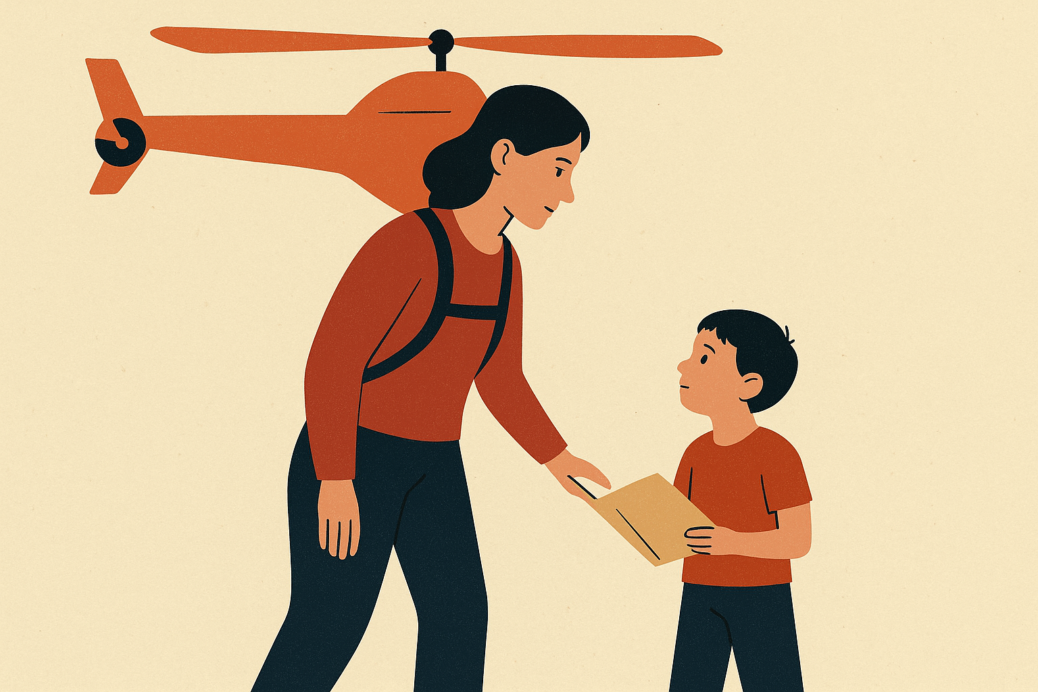
How Demographics Are Quietly Rewriting the Rules of Child Raising
Key takeaways
Today’s intense parenting styles, often labelled as “helicopter parenting,” aren’t just cultural fads or generational quirks.
They’re rooted in deeper societal and demographic changes—how we live, work, and raise children in modern Australia (and the Western world more broadly).
Helicopter parenting is a side effect of progress—smaller families, delayed parenthood, more affluence, and educational attainment.
But in giving our children everything, we may be holding back what they need most: the chance to struggle, stumble, and grow.
We often think of parenting trends as personal choices or cultural fads.
But many of the shifts we’re seeing today, especially what’s now known as “helicopter parenting”, have much deeper roots.
In fact, they’re driven by powerful demographic and societal forces.
You’ve probably noticed it: parents hovering over every aspect of their child’s life, from schoolwork to friendships to playground safety.
And while the intention is often noble, after all, we all want the best for our kids, the outcomes aren’t always so clear-cut.
Demographer Simon Kuestenmacher and I recently discussed this trend in our latest episode of Demographics Decoded, and what we found was surprising.
Helicopter parenting isn’t just a generational quirk.
It’s a response to sweeping changes in how we live, work, and raise families.
In this episode of our podcast we explored what’s really going on and what it means for raising resilient, capable children.
For weekly insights and strategic advice, subscribe to the Demographics Decoded podcast, where we will continue to explore these trends and their implications in greater detail.
Subscribe now on your favourite Podcast player:
More time, more control: how modern parenting got here
One of the most astonishing statistics comes from the US (with similar patterns here in Australia): today’s parents spend around 50% more time actively engaging with their kids than parents did in the 1970s.
According to Simon, “US parents now spend over 100 more minutes a day with their kids than they did fifty years ago.”
And this isn’t passive time, it’s structured, supervised, and focused on “enriching activities” like educational play, homework help, or curated outings.
This surge in interaction isn’t inherently bad.
In fact, it reflects a deep commitment to children’s success.
However, it also coincides with a shift away from unsupervised, unstructured free play, which is an essential component of childhood development.
And therein lies the concern.
The demographics behind this trend
So, what’s really driving this seismic shift in parenting style?
According to Simon, several demographic forces are converging:
1. Smaller families = bigger focus per child
As fertility rates fall, families are having fewer children.
In practical terms, this means that parents, especially millennial parents, are dedicating more time, energy, and resources to each child.
Where previous generations relied on siblings for companionship, modern kids often rely on parents instead.
Simon explains:
“There’s a vacuum in the home where siblings once filled the social space. So parents step in. It’s not inherently bad, but it does reduce opportunities for kids to self-organise, play independently, and navigate social challenges on their own.”
The irony?
While we’re trying to give our kids more opportunities, we may be limiting the very ones that matter most.
2. Older parents = more risk-aversion
Today, most first-time parents are in their mid-30s, roughly a decade older than previous generations.
And that extra decade matters.
As we age, we naturally become more cautious.
It’s why teenagers push boundaries and middle-aged adults seek security.
“I catch myself saying things like ‘don’t fall!’ at the playground,” Simon admitted. “Even when the risk is minor, my instinct is to intervene. That’s what 42 years of life experience does.”
This hyper-awareness of risk often leads to overprotection.
But resilience isn’t built in cotton wool.
It’s developed through trial, error, and yes, occasional bruises.
3. Richer, more educated parents = more micromanagement
With greater financial stability and higher levels of education, today’s parents also have more tools to shape their children’s environment.
That includes enrolling them in coding classes, language immersion programs, and a wide range of extracurricular activities.
On the surface, that’s a good thing.
But Simon warns that this level of involvement can backfire:
“The more you can afford, the more you feel obligated to provide. You want the best for your child, and now you can give it. But sometimes, that turns into over-management.”
And it’s not just about money.
Education plays a role, too.
In the past, when only 10–20% of Australians had degrees, teachers were revered as experts.
Today, with over half of school leavers going on to university, parents often feel they can, and should, intervene in the classroom.
When parental involvement goes too far
One area where this overreach is becoming particularly evident is in schools.
Simon pointed out that teachers today are under pressure not just to educate, but to act as counsellors, social workers, and even surrogate parents.
But while parental engagement can be valuable, it has its limits.
“I wouldn’t want to be a teacher these days,” Simon admitted. “You’re not left alone to do your job. Parents challenge marks, assignments, and even university lecturers are fielding calls from parents. I’ve heard stories of parents trying to intervene in job applications that would’ve been unthinkable decades ago.”
The unintended consequence?
We’re undermining the very systems that teach kids accountability and independence.
The vanishing art of free play
Perhaps the biggest loss in all this is the decline of unsupervised play, what used to be the bedrock of childhood.
Simon shared a striking insight:
“Free play only starts about 45 minutes after kids begin playing. That’s when creativity and self-regulation kick in. But we rarely allow kids that time anymore. Every moment is scheduled, supervised, or screen-based.”
Whether it’s due to homework loads, screen-time restrictions, or packed extracurricular calendars, kids are missing out on the very experiences that teach them how to resolve conflicts, take initiative, and learn from failure.

Helicopter parenting’s long-term impact
So what happens when kids don’t get to struggle a little?
Simon compared it to trees in a greenhouse:
“Without wind, trees don’t grow strong roots. The second they’re exposed to the real world, they topple. That’s what happens when kids are shielded from disappointment.”
He’s not advocating trauma.
Far from it.
But micro-failures, like missing the bus, getting a bad mark, or losing a game, are essential experiences.
They prepare kids for the inevitable ups and downs of adult life.
This is particularly relevant now, as younger generations report record levels of anxiety and stress when faced with everyday adult responsibilities.
What should parents do instead?
The takeaway isn’t that we should disengage; it’s that we should recalibrate.
Simon’s advice is clear:
“Park the helicopter. Let your kids walk or cycle to school if it’s safe. Give them time for unsupervised play. Don’t jump into fixing every problem. That’s how they learn.”
He also challenged the idea that the world is more dangerous than it once was.
Statistically, our cities are safer than when many parents themselves were kids.
The perception of danger has grown, even as actual risks have declined.
We need to shift our mindset from protection at all costs to preparation for real life.
A final thought
It’s tempting to see helicopter parenting as a personal or generational issue.
But really, it’s a side effect of modern life, of longer working hours, higher expectations, smaller families, and more competitive landscapes.
The irony is that while we’re giving our children more time and attention than ever before, we may not be giving them what they need most: independence, resilience, and space to grow.
As Simon put it so well:
“You can’t break your kids that easily. Let them climb. Let them fall a little. Let them figure things out. That’s how they become strong.”
And maybe, just maybe, the most loving thing we can do is step back, just enough, for them to step forward.
If you found this discussion helpful, don’t forget to subscribe to our podcast and share it with others who might benefit.
Subscribe now on your favourite Podcast player: