

What the Latest Mortgage Insights Tell Us About Australia’s Property Market
Key takeaways
Investors are back in charge. Their confidence in the market signals optimism for growth, but also raises affordability challenges for homebuyers.
Homebuyer activity is shifting east. Queensland and the smaller states are benefiting most, while WA cools after its strong run.
Supply remains the Achilles’ heel. New builds are falling further behind demand, setting the stage for continued price pressures.
Refinancing is evolving. More borrowers are negotiating better deals with their existing lenders, a trend worth watching as rates move lower.
Australia’s housing market is showing its usual resilience, but the landscape is shifting in some important ways.
The latest Mortgage Insights Report from Money.com.au reveals that while overall lending growth has slowed, investors are roaring back into the market and, for the first time in years, are almost neck and neck with homebuyers when it comes to new loans.
This obviously has significant implications for affordability, housing supply, and the balance of power between investors and owner occupiers.
Investor lending back in force
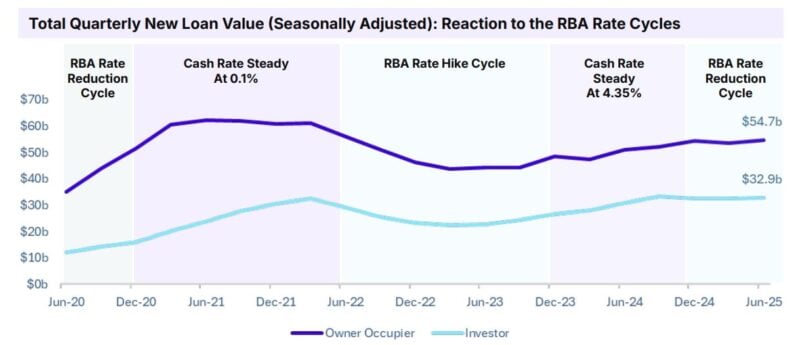
Investor lending rose 12% in the year to June 2025, easing from last year’s 19%, but still expanding at three times the pace of owner-occupier lending, which managed just 4% growth.
Source: Money.com.au
In fact, investors accounted for 38% of all new lending, the largest share since 2021.
With 196,699 loans issued, volumes are close to their 2022 peak, clear evidence that investors see opportunity as interest rates come down and rental yields rise.

Tip: This shouldn’t surprise us. Property investors tend to move faster than owner-occupiers when they see a window of opportunity.
With falling rates, tighter rental markets, and expectations of capital growth, investors are moving in while many first home buyers remain on the sidelines.
Homebuyers shift back East
One of the more interesting shifts in the report is geographic.
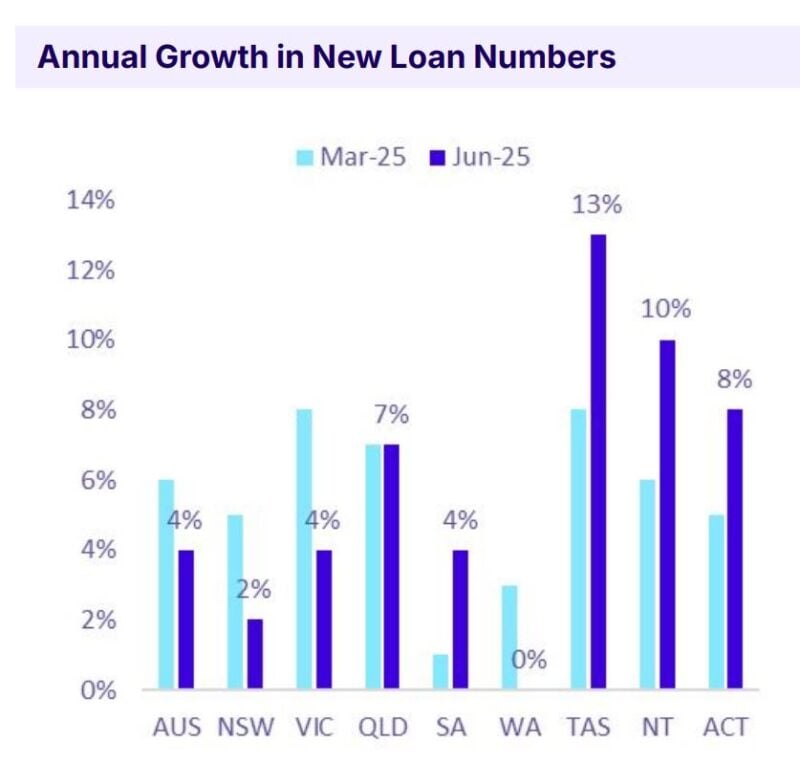
Queensland stood out with the strongest annual growth in owner-occupier loans at 7%, while Western Australia, the darling of the market over the last few years, recorded no growth for the first time since mid-2024.
Source: Money.com.au
We’re also seeing momentum in smaller markets like Tasmania (+13%), the Northern Territory (+10%), and the ACT (+8%).
This reflects both affordability constraints in the bigger cities and the ongoing search for liveability and value.

Note: In simple terms: WA is cooling, the East Coast is heating up again, and the smaller states are attracting buyers who can’t or won’t stretch for Sydney or Melbourne.
New builds still in trouble
If you’re hoping that new construction will solve Australia’s chronic housing shortage, the data isn’t encouraging.
Loans for new dwellings fell sharply, down 8% in the year to June 2025.
Construction loans slowed from 9% growth to just 3%, and land loans slid further into negative territory.
This is the reality of our supply problem: even as demand rebounds, supply-side constraints remain.
Without a major turnaround in construction capacity, increased demand risks driving prices higher rather than bringing balance to the market.
Refinancing returns, but with a twist
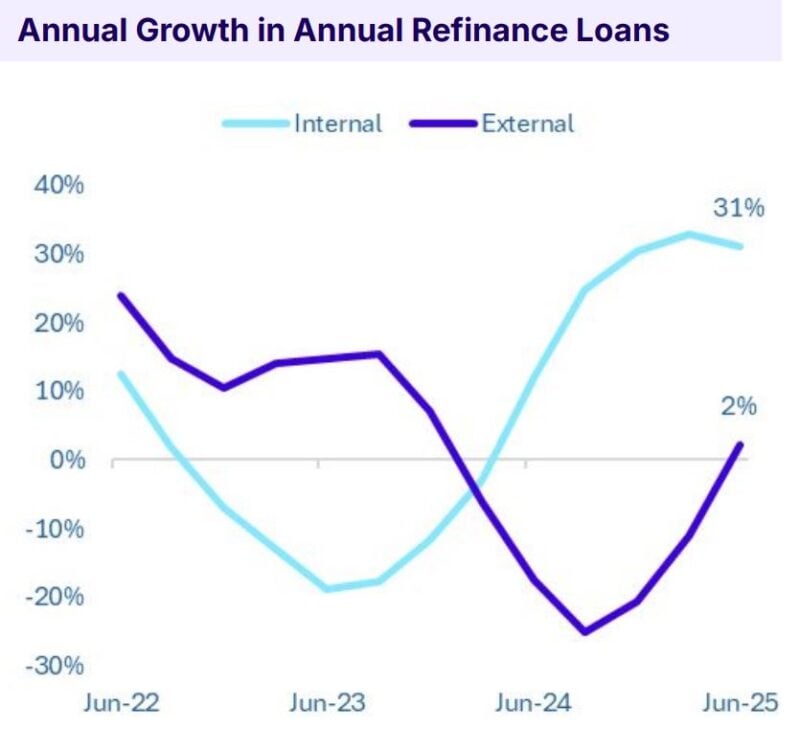
Refinancing is back near record highs, with 585,317 loans over the year, just shy of the 2023 peak.
But here’s the twist: borrowers are increasingly refinancing with their existing lender, rather than shopping around.
Internal refinancing jumped 31% compared to just 2% growth externally.
Source: Money.com.au
That suggests banks are working harder to hold onto their customers, while many borrowers prefer the convenience of staying put rather than switching lenders.
The bottom line
Australia’s property market is entering a new phase.
Investors are back in force, owner-occupiers are re-emerging, but without an improvement in housing supply, we risk repeating the same cycle of rising prices and affordability challenges.
For seasoned investors, this environment represents opportunity with strategic property investment being the key to building long-term wealth while contributing positively to the broader housing market.
If you’re like many property investors, you’re probably wondering what’s the right thing to do at present.
Should you buy, should you sell, or should you just wait?
You can trust the team at Metropole to provide you with direction, guidance, and results.
Whether you’re a beginner or an experienced investor, at times like we are currently experiencing you need an advisor who takes a holistic approach to your wealth creation and that’s exactly what you get from the multi-award-winning team at Metropole.
We help our clients grow, protect and pass on their wealth through a range of services including:
- Strategic property advice – Allow us to build a Strategic Property Plan for you and your family. Planning is bringing the future into the present so you can do something about it now! Click here to learn more
- Buyer’s agency – As Australia’s most trusted buyers’ agents we’ve been involved in over $4Billion worth of transactions creating wealth for our clients and we can do the same for you. Our on the ground teams in Melbourne, Sydney, and Brisbane bring you years of experience and perspective – that’s something money just can’t buy. We’ll help you find your next home or an investment-grade property. Click here to learn how we can help you.
- Property Development – We enable you to become an “armchair developer” and get all the benefits of property development without getting your hands dirty. We take the hassles out of your investment by assisting you with all the expertise you need, from concept to completion, including construction. Click here to see if it’s the right way for you to grow your portfolio.
- Wealth Advisory – We can provide you with strategic tailored financial planning and wealth advice. Click here to learn more about we can help you.
- Property Management – Our stress-free property management services help you maximise your property returns. Click here to find out why our clients enjoy a vacancy rate considerably below the market average, our tenants stay an average of 3 years, and our properties lease 10 days faster than the market average.
